The homepage covers what you get and why it matters, in plain English. This page is the detail underneath — the tools, the specific threats they catch, and the standards they map to — for the technical or compliance-minded reader who wants to look under the hood.
Your security isn't watched through a black box you can't see into, and it isn't someone else's product with our name stuck on it. Most managed-security shops resell another company's stack and configure a dashboard. BlackWall is different: the SOC platform that monitors your environment — Sentinel — and the offensive engine that tests it — KAORS — were designed and written in-house, from the detection logic to the reporting pipeline. When you ask how a detection works or why an alert fired, you're talking to the person who wrote it. That's the clearest competency signal we can give you: we don't just operate security tooling — we engineer it.
A simulated event stream — demo data — showing the kinds of alerts Sentinel surfaces in real time.
Most firms either watch your network or attack it. BlackWall does both — and each side makes the other sharper.
We watch the four places attacks actually land — your Microsoft 365 logins, your computers, your DNS traffic, and your network edge — and alert you the moment something looks wrong.
Scoped, fully authorized engagements that probe your environment the way a real attacker would — then hand you a clear, prioritized path to fixing what we find.
Not "we monitor your logs." These are the specific adversary behaviors Sentinel is built to detect, grouped by where they land and mapped to MITRE ATT&CK — so for any alert, we can show you the technique that triggered it.
Every detection here is built, mapped to MITRE ATT&CK, and validated by Sentinel's automated test suite — not an aspirational feature grid. Several have been exercised end-to-end against genuine attacker techniques on live Windows telemetry, including credential brute-force (Atomic Red Team, T1110) and unauthorized admin-account creation. Monitoring of your own Microsoft 365, DNS, and firewall feeds is wired up and verified during onboarding. As new detections are added and tested, they appear here.
Detection is only half the job. Here's exactly what happens between an alert and a resolved incident — the same chain, every time, from first signal to your notification.
On a validated threat, and with your authorization, the response can:
Who's watching at 2 AM? 24/7 automated detection, with human response when it matters. Sentinel runs continuously — correlation and real-time alerts are built to fire the moment something matters, whatever the hour. When an alert escalates, a named practitioner — the person who built the platform — personally reviews and responds to it. There's no overnight analyst desk, and I won't pretend there is. Automated detection around the clock plus direct practitioner response is the model, and that direct access is exactly the point.
No rip-and-replace projects. No weeks of professional services. Onboarding is designed to be hands-off for your team.
A short scoping call, a signed authorization, and a clear statement of work. Every engagement — monitoring or testing — starts with explicit, written consent.
Your team runs a single installer per machine. The agent runs silently in the background, auto-starts on boot, and immediately begins forwarding events over HTTPS.
> blackwall-agent install --client=yourco ✓ done
Real-time alerts the moment something matters, automated triage with step-by-step containment playbooks for high-confidence threats, and client-ready PDF reports — incident summaries and pentest findings alike.
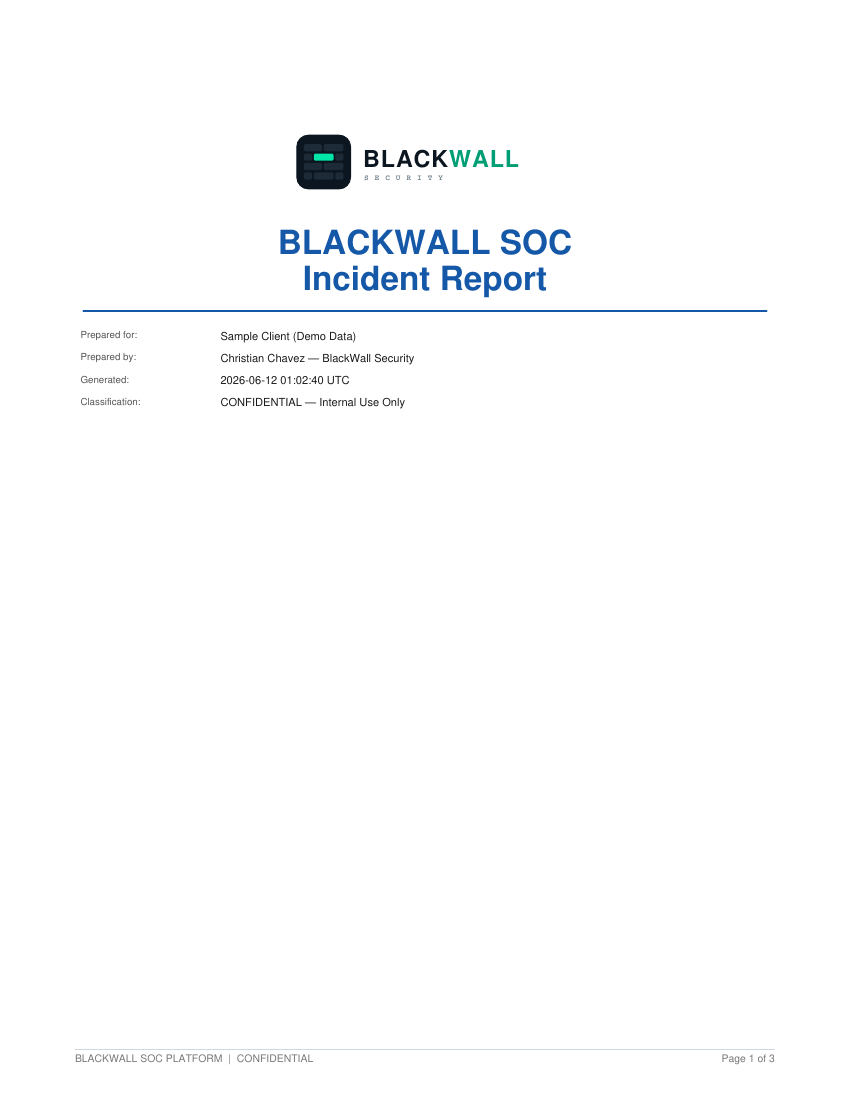
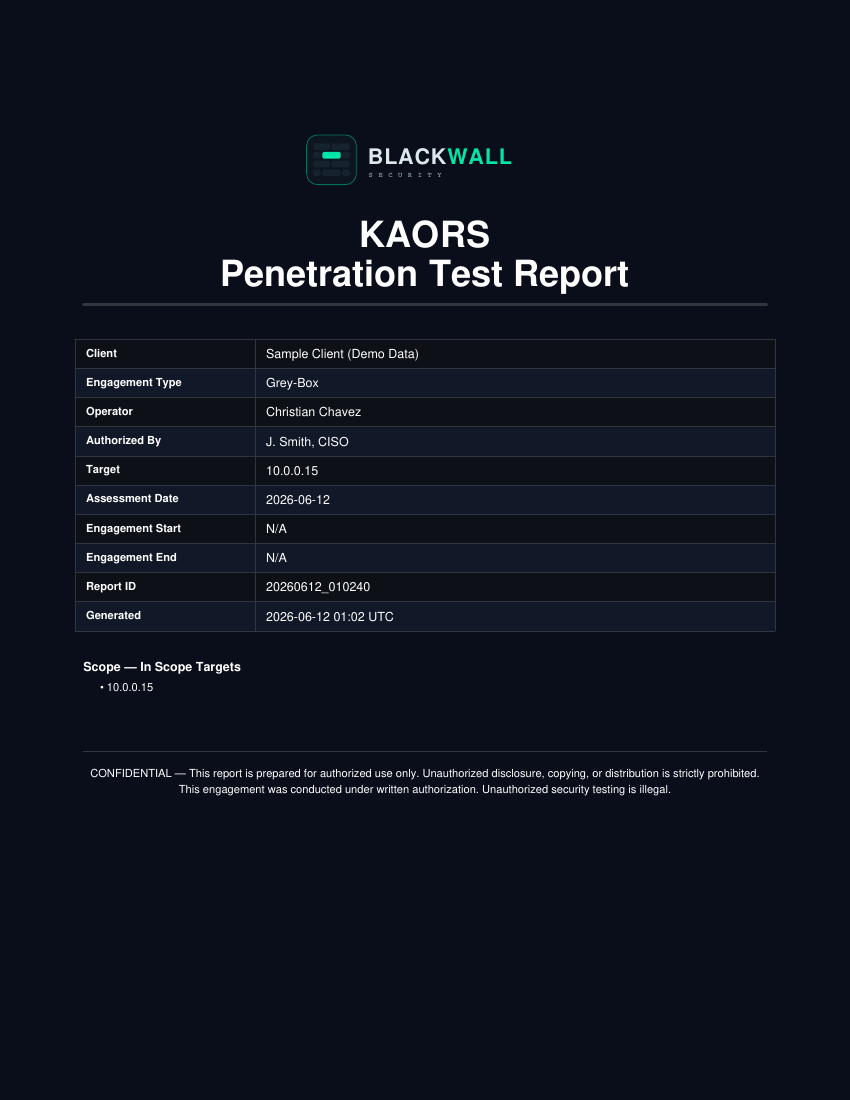
Not stock photos — these are real covers from BlackWall's reporting pipeline, shown here with representative data. Every engagement is delivered with documents like these.
Illustrative examples — not client results. These show the kinds of findings a small practice typically has, drawn from BlackWall's detection library. As engagements complete, real anonymized case studies will replace them.
BlackWall was engineered from day one for the things most providers bolt on later.
Each client gets a fully isolated database. Your security data never shares a table, a query, or a report with anyone else's. Zero cross-contamination, by architecture.
Every engagement starts with explicit written authorization and a signed scope — targets, timing, and techniques agreed up front. Exploitation runs only against what you approve, behind strict safety gates.
Polished PDF deliverables you can hand to leadership, auditors, or insurers — prioritized findings, plain-language impact, and concrete remediation steps.
One installer. No appliances, no network re-architecture, no agents fighting your endpoints. You're streaming events within minutes of signing.
Our testing and reporting map to the standards your business and your insurers require, so an engagement doubles as documented evidence for auditors and carriers. We help you meet these requirements and prove it — compliance itself remains your organization's responsibility.
Requirement 11.4 mandates human-led internal and external penetration testing at least annually. Our reports follow PTES and NIST SP 800-115 and are structured to meet it.
Requires regular technical evaluation of the safeguards protecting electronic PHI. Our testing and findings support that evaluation for healthcare organizations and their business associates.
Covers accountants, tax preparers, and insurance agencies — requiring a written security program with penetration testing and periodic vulnerability assessments. We deliver the testing and documentation it calls for.
Carriers increasingly require evidence of penetration testing, MFA, and patch management to issue policies and pay claims. Our reports provide the documentation underwriters ask for.
Beyond testing, the monitoring service is built around recognized security frameworks. Detections map to MITRE ATT&CK at the technique level; our coverage and controls align to the NIST Cybersecurity Framework (Identify, Protect, Detect, Respond, Recover) and the CIS Controls. For dental, medical, and legal practices, monitoring, tamper-evident logging, and incident response are structured to support HIPAA Security Rule safeguards for electronic PHI. We help you align to these frameworks and document it — we don't claim certification against them; compliance itself remains your organization's responsibility.
No — it complements them. Your antivirus blocks known malware; BlackWall SOC watches the bigger picture across four layers — your Microsoft 365 logins, your endpoints, your DNS traffic, and your network edge — catching account takeovers, privilege changes, malware command-and-control, and exposure your point tools miss. Keep your existing stack; we make it observable.
Only you and BlackWall. Each client gets a fully isolated database — your events, alerts, and reports never share storage or queries with another client's. Data travels exclusively over encrypted HTTPS.
Engagements are scoped in writing before anything runs. Exploitation is gated behind explicit safety controls and only executed against targets you've authorized. You define what's in scope and out of scope — we never test beyond it.
Engagements are scoped per environment — machine count for monitoring, target scope for testing. Request a consultation and you'll get a clear, fixed quote with no surprise line items.
Start with an External Security Check — an outside-in look at what's exposed, with a plain-English report. No access to your systems needed.
Get My Security Check →